Why Real Businesses Still Need Real Websites
Social media is brilliant at forming habits, but weak as a business foundation. Real websites still win because search intent, trust, ownership, and compounding content create durable profit.
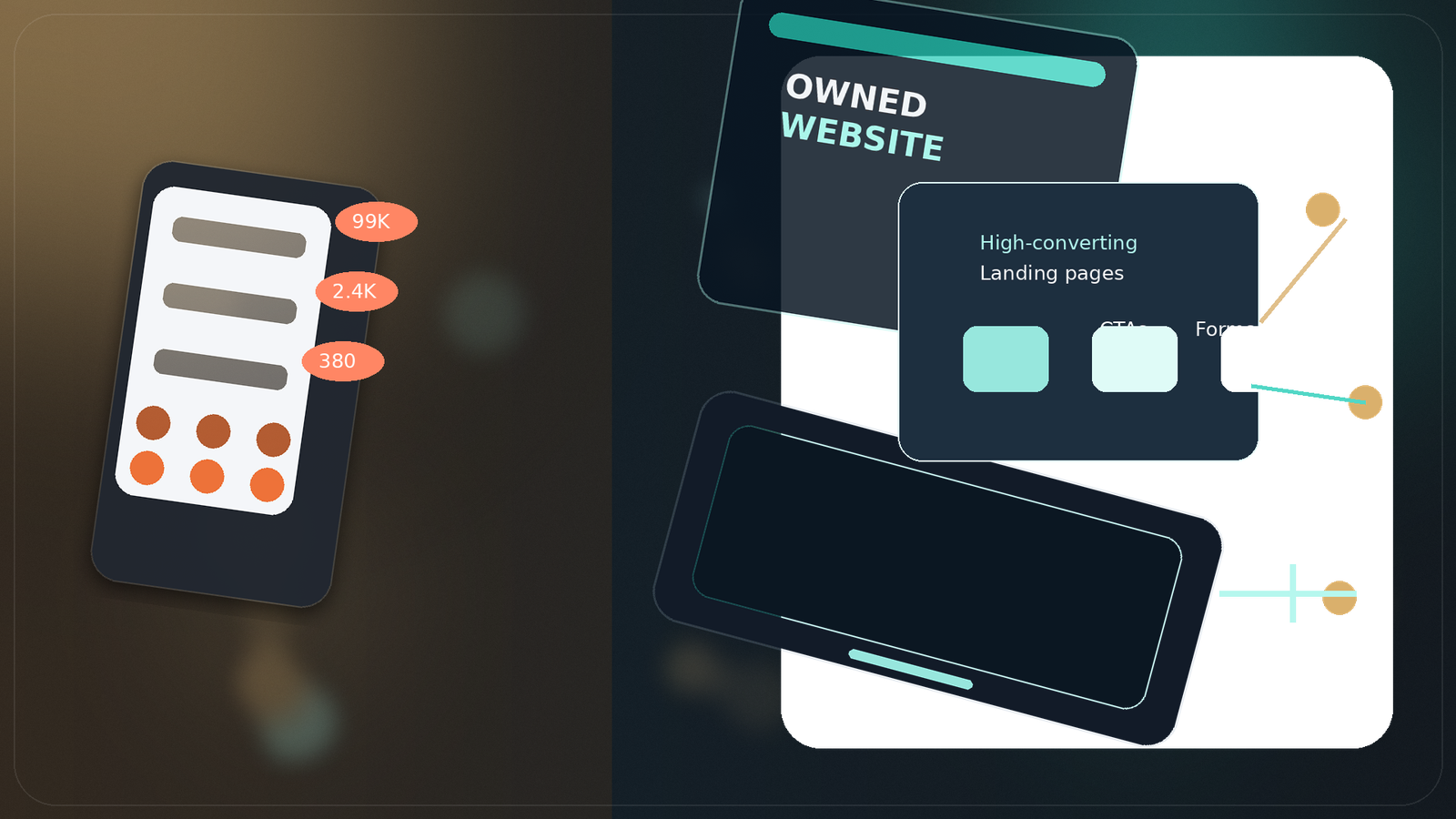
For years, small businesses have been sold a seductive shortcut: skip the website, post more on Instagram, let TikTok do the selling, treat Facebook like the shopfront. It sounds modern. It also creates a fragile business. Social platforms are excellent at keeping people scrolling, but attention is not the same as intent. A real website still matters because it gives the business something social media never will: a search-visible, trust-building, conversion-focused asset it actually owns.
53%
Organic Search
BrightEdge research puts organic search at 53% of trackable website traffic.
Source: BrightEdge
5%
Organic Social
The same BrightEdge channel report describes organic social as flat at roughly 5%.
Source: BrightEdge
18h 36m
Weekly Feed Time
DataReportal's 2026 overview says the typical online adult spends this much time each week on social and video feeds.
Source: DataReportal
41%
Social Instead
Small Business Majority found that among owners without a website, 41% use social media instead.
Source: Small Business Majority
Social Media Is Habit Forming, Not Profit Forming
Social media feels enormous because it is designed to feel enormous. The feed is always moving, the next post is always loading, and the platform rewards whatever keeps users inside the app for another few seconds. DataReportal's 2026 global overview puts typical social and video feed consumption at 18 hours and 36 minutes per week. That is not a small behaviour. It is a habit loop.
But a habit loop is not the same as a buying journey. Most people scrolling a feed are filling time, reacting to content, or escaping boredom. They may notice a brand. They may even like a post. But they are not necessarily trying to buy, book, compare, or solve a problem. That is the gap too many businesses miss: social platforms are built to capture attention; websites are built to turn intent into action.
Search Still Carries The Commercial Intent
A person searching for "accountant in Dover", "emergency plumber near me", or "website design for charities" is not behaving like a passive follower. They are actively trying to make progress. That is why the traffic mix matters so much. BrightEdge research reports organic search at 53% of trackable website traffic, while organic social sits at roughly 5%. Even if the exact split varies by industry, the direction is hard to ignore.
Search is not glamorous in the way a viral reel is glamorous. It does not give the same dopamine hit. But it does something far more valuable for serious businesses: it catches people at the moment they are looking for an answer. A well-built business website can keep winning those moments for years.
Rented Attention Is A Fragile Business Model
A social profile is not an owned asset. The platform controls the feed, the reach, the rules, the moderation system, and the relationship with the audience. If reach drops, the business pays. If an account is suspended, the business waits. If the platform goes down, the business loses access to the audience it thought it had built.
That is not theoretical. During the 2021 Facebook, Instagram, and WhatsApp outage, Time reported on small businesses that suddenly lost access to critical traffic, customer communication, and sales channels for nearly six hours. One founder told Time that 95% of her site traffic came from Instagram and her income was fully dependent on that audience. That is not a marketing channel. That is a single point of failure.
Owned Infrastructure
Is your business building an asset or feeding an algorithm?
A proper website gives your best prospects somewhere stable, searchable, and credible to land.
Build the WebsiteThe No-Website Gap Is Still Real
The worrying part is how many businesses are still treating social media as a replacement for infrastructure. Small Business Majority reported in 2024 that about one-third of small business owners did not have a business website, and 41% of those without one were using social media presence instead. That is a huge number of companies building their visibility on someone else's property.
This creates a strange digital economy: businesses spend hours feeding platforms that may only send a small share of website traffic, while neglecting the one place where trust, search visibility, content, enquiries, analytics, and conversion can compound together. A post is temporary. A useful website page can keep earning.
Websites Compound While Social Posts Decay
The best social posts still have a short commercial shelf life. They spike, fade, and get buried. A strong website page behaves differently. It can be indexed by search engines, linked by other websites, referenced by AI systems, shared in proposals, updated over time, and connected to a proper enquiry journey.
That compounding effect is why established businesses still invest in their websites even when they have large social followings. The website is the asset. Social is distribution. The mistake is treating the distribution channel as if it were the business itself.
Use Social, But Build On Your Own Ground
None of this means social media is useless. It is useful for awareness, personality, community, paid campaigns, and showing the human side of a business. But it should feed the website, not replace it. The strongest model is simple: use social for discovery, move serious visitors to your website, and convert them on infrastructure you control.
A real website gives the business a durable home: its own domain, its own content, its own analytics, its own enquiry flow, and its own search authority. Social media can create attention. A website turns the right attention into profit.
Website Strategy
Ready to stop renting attention?
Social can support growth, but your real commercial foundation should be a website you own and control.
Plan the AssetRelated Insights
Keep Building The Topic Cluster
These pieces reinforce the same commercial themes and lead naturally into proof, services, and stronger enquiry paths.
Crypto Payments
Crypto Payments for Websites Should Feel Boring, Secure, and Fast
Why accepting crypto online is not about looking futuristic; it is about giving serious buyers a faster, cleaner payment path without adding risk or operational mess.
Read InsightMedia SEO
The FY Times Shows Why Niche Publishing Still Needs Owned Search Assets
Why specialist publishers and editorial brands should build search-friendly owned websites, and why clear topical authority still matters in an AI-heavy search market.
Read InsightAI Search
AI Search Still Rewards Technical SEO and Clear Site Structure
Why AI Overviews and AI Mode do not replace SEO fundamentals for premium service sites, and why internal links, text clarity, and crawlable proof matter more than ever.
Read Insight